
.png)
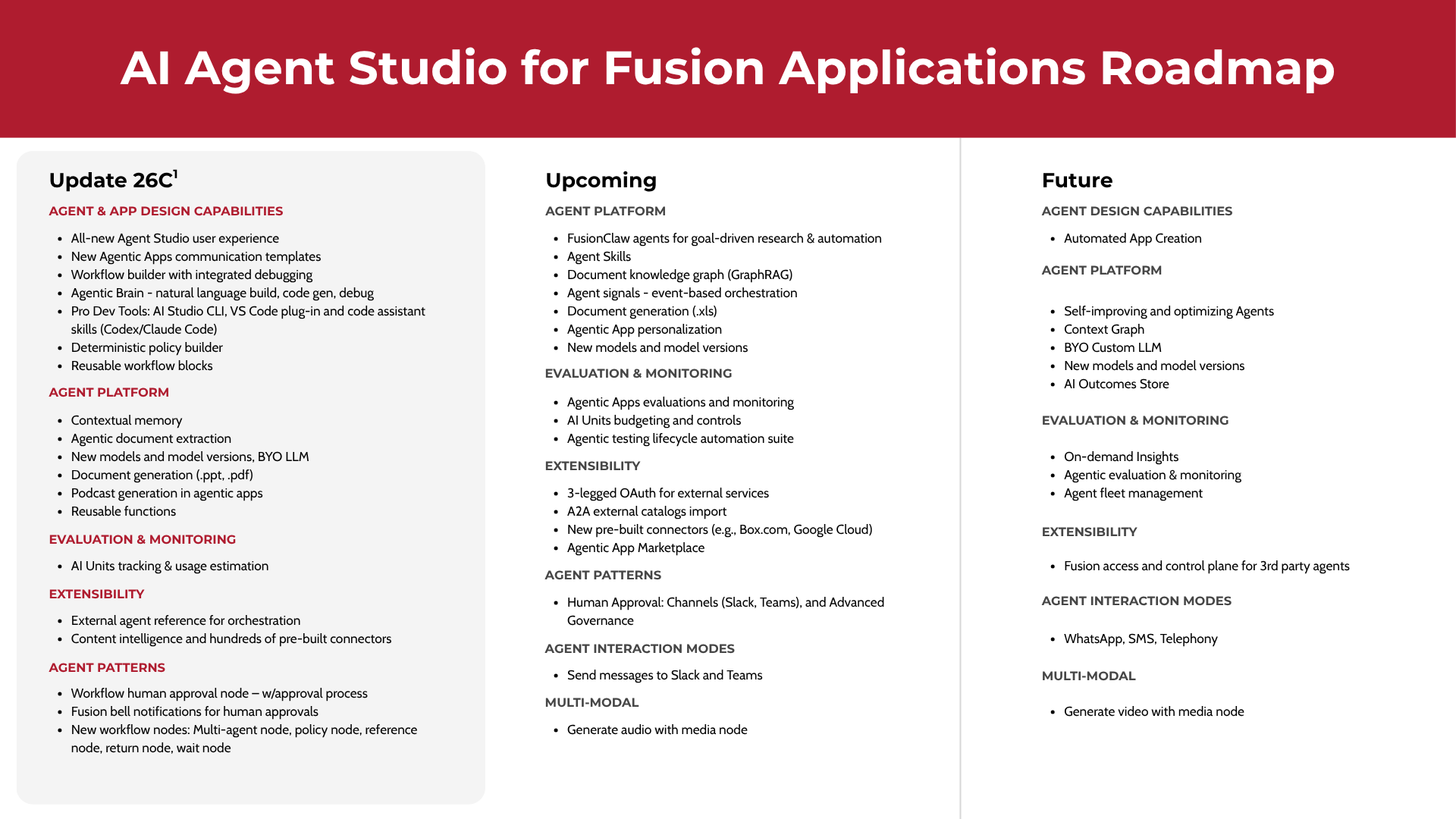
Oracle continues to invest in AI Agent Studio for Fusion Applications, and the 26C release introduces several enhancements designed to improve the user experience, expand development options, and increase platform flexibility. According to Oracle's AI Agent Studio roadmap, the release includes updates across agent and application design capabilities, agent platform functionality, evaluation and monitoring, extensibility, and workflow orchestration.
While the roadmap outlines a broad set of new capabilities, four key updates in 26C stand out for building, testing, and managing AI agents within Oracle Fusion Applications.
1. AI Agent Studio Updated Pricing Model
One of the most significant changes in the 26C release is the updated pricing model. Oracle is moving away from the previous custom and included tier structure in favor of a broader agent usage model.
Importantly, this change is not limited to token consumption associated with large language model (LLM) nodes. Instead, pricing is based on overall agent usage, providing a more comprehensive view of how organizations consume AI Agent Studio resources. As organizations continue to expand their AI initiatives, understanding how agents are utilized across the platform will become increasingly important.
This update aligns with Oracle's broader focus on evaluation and monitoring capabilities. The AI Agent Studio roadmap also introduces AI unit tracking and usage estimation, providing additional visibility into agent consumption and activity.
2. New App & Agent Design Capabilities in AI Agent Studio
New AI Agentic Studio UI & UX
Users upgrading to 26C will likely notice a significant change as soon as they log into AI Agent Studio. The platform's interface has been refreshed, creating a noticeably different user experience while preserving the core functionality users rely on today.
The new landing page introduces a more streamlined interface centered around a natural language prompt, making it easier for users to begin designing AI agents immediately. Oracle's decision to place natural language development front and center signals its continued investment in making agent development more intuitive and accessible.
The roadmap also highlights communication templates, integrated debugging capabilities, reusable workflow blocks, and deterministic policy-building functionality, helping streamline the process of designing, testing, and managing AI agents.
New Agentic Brain Capability in AI Agent Studio 26C
One of the most notable additions to the AI studio development platform is Agentic Brain, a capability that allows developers to design and debug agents using natural language. Rather than manually configuring every aspect of an agent, developers can prompt the large language model (LLM) to better understand an application, assist with debugging, and simplify the development process. Developers still retain the ability to manually build workflows and navigate AI Agent Studio as they have in previous releases, with the refreshed experience presenting those capabilities through a more condensed and modern interface.
3. Security Conscious Functionality in AI Agent Studio
Communication Templates Introduce Additional Guardrails
One of the more practical additions in 26C is expanded support for communication templates. Organizations can now configure document-based communication templates that provide greater control over how agents generate emails and other outbound communications. Developers can determine which portions of a communication an agent is allowed to generate, including recipients and message content, introducing additional governance and flexibility for enterprise AI deployments.
Updated Policy Templates
Oracle has expanded policy capabilities in 26C, providing a more structured approach for decisioning in workflows. Instead of treating policies only as response controls, developers can now create policy models that help provide reliable, repeatable, and deterministic decisions at runtime.
Users can develop a standalone policy model or a reusable policy template. In both cases, policy rules can be defined by uploading source policy documents or entered manually, and AI Agent Studio is able to generate functions that convert those business policies into executable logic.
In this new update, Oracle also added a stronger validation flow. Generated policy functions can be reviewed and tested in detail with generated or uploaded test cases before deploying to production.
Finally, Oracle also supports security roles and context scoping, so policy models can be limited to the right users and tied to the specific workflows when needed. Overall, these updates to policies make them more reusable, testable, and operationally useful for governing and securing agent decisions in enterprise systems.
4. AI Agent Studio Developer Oriented Tooling
MCP Connectors Expand Integration Options
The introduction of MCP connectors expands the versatility of AI Agent Studio by providing connectivity options that have become increasingly common across modern AI development platforms. Oracle has also introduced additional software connectors, extending the platform's ability to integrate with existing enterprise systems and creating additional opportunities for automation and orchestration.
This enhancement aligns with Oracle's broader extensibility strategy, which includes external agent references for orchestration, content intelligence capabilities, and access to hundreds of pre-built connectors.
AI Agent Studio Command Line Interface (CLI) Development
Oracle has introduced a Command Line Interface (CLI) option for AI Agent Studio development. Developers can now work within preferred code-based environments, including Visual Studio Code and other editors.
The CLI also enables developers to leverage AI-assisted coding tools such as Claude and Codex during development. Rather than working exclusively within the graphical Studio interface, developers can incorporate modern code editors and AI coding assistants into their workflow while Oracle continues to support both visual and code-based development approaches.
Additional AI Agent Studio 26C Enhancements
Oracle has expanded policy management through policy models, policy templates, and policy management capabilities that provide a more structured approach to defining how AI agents should respond. Developers can configure prompt expectations, test policy behavior, refine responses, and incorporate security rules to help ensure agents only return information users are authorized to access.
The release also enhances monitoring and evaluation by introducing additional metrics beyond correctness, including API errors, latency, token usage, and coverage. These additions provide more comprehensive insight into agent performance as applications become more sophisticated.
Beyond these updates, the 26C roadmap introduces contextual memory, reusable functions, additional model support, document generation, podcast generation, multi-agent workflow nodes, policy nodes, return nodes, wait nodes, and enhanced human approval workflows.
Looking Beyond AI Agent Studio 26C
The roadmap also provides insight into Oracle's future direction for AI Agent Studio, including Agent Skills, document knowledge graphs, event-based orchestration, additional monitoring capabilities, expanded personalization, self-improving agents, advanced evaluation capabilities, expanded communication channels, and additional AI models. Together, these initiatives highlight Oracle's vision for a comprehensive enterprise AI platform.
What's Next?
Oracle AI Agent Studio 26C expands how organizations can build, manage, secure, and evaluate AI agents within Oracle Fusion Applications. From natural language development and Agentic Brain to communication guardrails, the update provides greater flexibility and control across the agent development lifecycle.
As these capabilities continue to evolve, organizations should consider how new development tools, governance controls, integrations, and evaluation capabilities fit within their broader enterprise AI strategy.
Check out Elire's expert videos, 4 Key Oracle AI Agent Studio 26C Updates and Diving into Oracle AI Agent Studio 26C: A New Look and New Capabilities for a quick overview of the latest AI Agent Studio 26C updates.
If you're exploring Oracle AI Agent Studio, agentic applications, or broader AI initiatives within Oracle Fusion Applications, Elire can help. Connect with our experts to discuss your AI strategy and implementation roadmap. Subscribe to our monthly Cloud Newsletter and follow Elire on LinkedIn for Oracle Cloud and AI insights. Looking for more Oracle updates? Check out Elire's YouTube channel for new Oracle overviews, how-tos, and product demos.

.png)

.png)
.png)