

.png)
The Migration Milestone Has Passed. The Operating Work Has Not.
For treasury and finance leaders, the framing of ISO 20022 as a one-time migration project is becoming a limiting perspective. For ISO 20022 2026, the more consequential question is not whether your organization met the technical deadlines, it is whether your operating model is positioned to function effectively under the new rules that now apply to specific payment rails and message types.
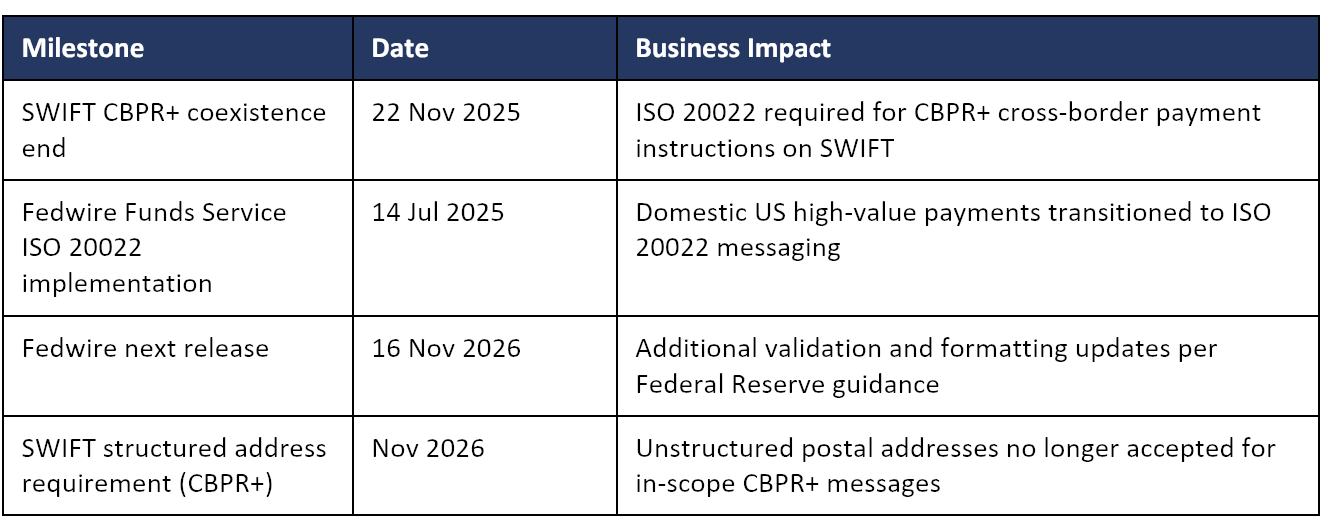
SWIFT's CBPR+ coexistence period closed on 22 November 20251. For cross-border payment instructions in scope of CBPR+, ISO 20022 is now the required standard on the SWIFT network. Organizations that treated that date as the finish line are discovering that meeting the deadline and being operationally ready are not the same outcome.
What Has Changed, and What Is Still Ahead for ISO 20022 in 2026
The regulatory and market timeline has moved faster than many internal programs anticipated, and the scope of what has changed varies by payment rail and message family.
In the United States, the Federal Reserve implemented ISO 20022 for the Fedwire Funds Service on 14 July 2025, per the Federal Reserve Financial Services published implementation announcement3. The Federal Reserve has also published guidance for a further Fedwire release scheduled for 16 November 2026, with testing and readiness materials available through the Fed's ISO 20022 Implementation Center4,7. Treasury organizations that consider their Fedwire compliance settled should revisit that position against the November 2026 release scope.
On the cross-border side, SWIFT's post-coexistence guidance identifies structured address requirements as a near-term operational priority. For CBPR+ in-scope messages, only fully structured or hybrid postal addresses will be accepted after the November 2026 SWIFT deadline5. Organizations should confirm scope with their SWIFT-connected banking partners rather than assume a uniform impact across all payment types.
SWIFT's published post-migration commentary indicates that a significant share of payment messages continued to carry unstructured address data well into 20266. Firms should validate their own exposure using bank-supplied data rather than industry averages, but the direction of travel is clear: unstructured address data is now an operational risk, not a formatting preference.
The Business Risks Hiding in Plain Sight
Treasury and finance leaders should be less focused on message formats and more focused on what unresolved data quality issues will cost operationally.
Organizations with legacy payment files carrying inconsistent address formatting, limited remittance detail, or bank-specific workarounds are exposed to failed validations, delayed payments, rejected transactions, and increased manual intervention by finance operations teams. These are not theoretical risks. They are the predictable outcome of deferred data remediation.
ISO 20022, where applicable, touches cash visibility, bank statement quality, reconciliation, sanctions screening, and exception handling. Treating it as a payments-only issue leaves material operational exposure unaddressed across the broader finance function.
Where the Strategic Opportunity Sits
Organizations that approach ISO 20022 readiness as a process redesign will recover value that pure compliance programs will not.
Richer structured data can enable better automation, cleaner matching, more usable end-to-end references, and stronger visibility across the payment lifecycle2. These benefits are real, but they are conditional. They depend on the quality of upstream data and the integrity of mappings across the full payment chain, from ERP origination through TMS formatting to bank statement ingestion.
The most durable use of enriched payment data is improved cash forecasting visibility, meaning a clearer view of what was sent, what was received, and what remains outstanding. For treasury functions managing liquidity across multiple banks and entities, that clarity has direct operational and strategic value.
Four ISO 20022 Related Priorities for the Remainder of 2026
1. Audit payment master data for structural compliance.
The priority is identifying where unstructured addresses, free-text remittance fields, or inconsistent beneficiary records still exist in master data. These are the fields most likely to generate exceptions as ISO 20022 validation rules tighten on in-scope payment rails. The audit should cover ERP, TMS, and any bank portal where payment instructions originate outside centralized systems.
2. Engage banking partners on release-specific requirements.
ISO 20022 is a standard, but implementation details vary by payment rail, market, and bank. Banking partners maintain their own testing schedules, formatting expectations, and go-live timelines. Surprises at this layer are among the most common causes of delayed remediation programs. Formal bank engagement, rather than informal email threads, is the appropriate mechanism.
3. Validate end-to-end data integrity across the payment chain.
The benefits of ISO 20022 disappear if data is flattened or stripped during translation between systems. ERP-to-TMS mappings, TMS-to-bank formatting, and bank statement ingestion must all preserve the same key data elements. A document review of mapping specifications is not sufficient. End-to-end testing in a controlled environment, using representative payment scenarios, is the required standard.
4. Establish standing governance, not a one-time project.
ISO 20022 will continue to evolve through successive release cycles. The Federal Reserve has a November 2026 Fedwire release in motion4, and SWIFT continues to refine its post-2025 roadmap1. Treasury organizations that establish standing governance, with defined ownership across treasury, IT, and finance operations, will adapt more efficiently to each release. Without that structure, each cycle becomes a reactive event rather than a managed transition.
Diagnostic Questions Leadership Should Be Asking for ISO 20022 2026
Before commissioning an external assessment, finance leadership should pressure-test the following internally:
- Has the organization quantified the share of payment records with unstructured address data across in-scope rails?
- Are ERP-to-TMS field mappings documented and version-controlled against current ISO 20022 message schemas?
- Does a named owner exist for each banking partner relationship responsible for format and release alignment?
- Is the November 2026 Fedwire release on the IT and treasury project calendar with allocated testing time?
- Has payment exception volume been measured and trended since the November 2025 CBPR+ deadline?
If more than two of these questions lack a definitive answer, the organization likely carries more residual risk than its current posture reflects.
Implications for Treasury Technology Strategy
Organizations operating treasury management systems should use this period to evaluate whether their current connectivity architecture supports the structured data requirements ISO 20022 introduces, not only in message format but in the depth of remittance, address, and reference data that flows end to end.
The organizations best positioned for the next phase have standardized payment data at the point of origination in the ERP, reduced dependence on ad hoc bank-specific formatting, and established a single governance model across ERP, TMS, and banking partners where the same data rules are enforced at every layer. That architecture is not achievable through connectivity upgrades alone. It requires deliberate data governance decisions made at the process level.
The question for treasury and finance leadership is whether the current operating model can sustain structured, high-quality payment data across successive release cycles, or whether it will continue to require manual remediation each time regulatory standards advance.
Ready to assess your ISO 20022 priorities? Reach out to Treasury@elire.com to discuss your treasury technology strategy, data readiness, and next steps for 2026. Contact us to request our complimentary treasury assessment service offering PDF as well.
References
1. SWIFT. ISO 20022 Implementation FAQs. https://www.swift.com/standards/iso-20022/iso-20022-faqs/implementation
2. SWIFT. About ISO 20022. https://www.swift.com/standards/iso-20022
3. Federal Reserve Financial Services. Fedwire Funds Service ISO 20022 FAQ: Overview and Implementation Details. https://www.frbservices.org/resources/financial-services/wires/faq/iso-20022/overview-implementation-details
4. Federal Reserve Financial Services. November 2026 Release FAQs. https://www.frbservices.org/resources/financial-services/wires/iso-20022-implementation-center/november-release-faq
5. SWIFT. ISO 20022 FAQs (Structured Address Requirements). https://www.swift.com/standards/iso-20022/iso-20022-faqs
6. SWIFT. ISO 20022 in Bytes for Payments: The Journey Continues. https://www.swift.com/standards/iso-20022/iso-20022-bytes/journey-continues
7. Federal Reserve Financial Services. Fedwire Funds Service ISO 20022 Implementation Center. https://www.frbservices.org/resources/financial-services/wires/iso-20022-implementation-center


.png)