
.png)
A New Kind of User Interface
Moving Beyond Screens and Workflows
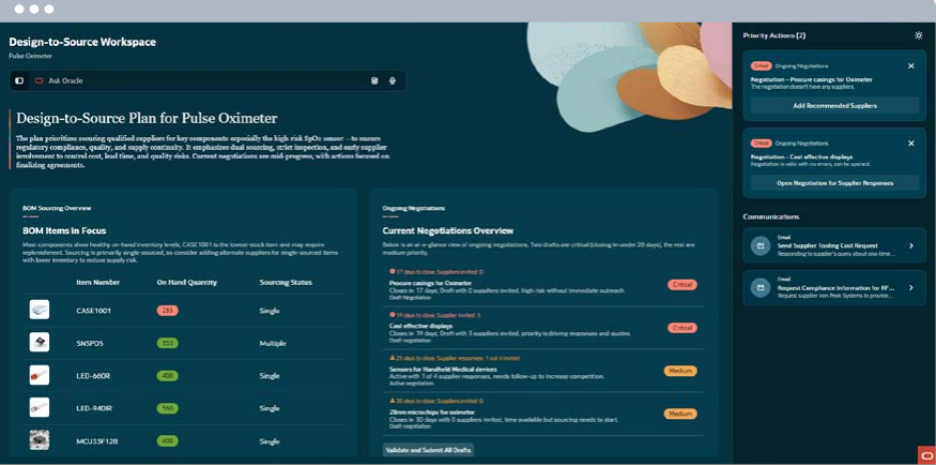
For decades, enterprise applications have followed a consistent interaction model. Users navigate menus, access forms, and execute predefined workflows to complete tasks. This structure has defined how ERP, HCM, and EPM systems operate. With the introduction of oracle fusion agentic applications, that model is evolving.
Instead of requiring users to know where to go and what to do, systems are becoming more outcome-driven. The interface is no longer just a set of screens. It is an intelligent layer that can interpret intent, orchestrate actions, and guide users through complex processes. This represents a fundamental shift in how enterprise systems are designed and used.
From Transaction Interfaces to Intent-Driven Interaction
Traditional systems are built around transactions. Every action requires a user to initiate a step, follow a process, and complete a task manually. Oracle Fusion agentic applications introduce an intent-driven model.
Instead of navigating:
- Users express a goal or request
- The system interprets context using embedded AI
- Actions are orchestrated across workflows and data sources
This is enabled through AI agents that operate within Oracle Fusion Applications. These agents can:
- Understand user intent through natural language
- Access and analyze relevant transactional and analytical data
- Execute multi-step processes across modules
- Provide recommendations based on historical patterns and business rules
The result is an interface that behaves more like a collaborator than a tool.
How Oracle Fusion Agentic Applications Work
At a technical level, oracle fusion agentic applications combine several components:
- Embedded AI models trained on enterprise data and process patterns
- Agent frameworks that define how tasks are executed and governed
- Application context layers that ensure agents operate within roles, permissions, and workflows
- Integration with Fusion data models across ERP, HCM, and EPM
These components allow agents to move beyond simple automation. Instead of executing a single task, they can plan and coordinate actions across multiple steps.
For example, an agent can:
- Identify an exception in a financial process
- Gather supporting data from multiple modules
- Recommend corrective actions
- Initiate or complete those actions within defined controls
This orchestration is what differentiates fusion agentic applications from traditional automation tools.
Embedded AI Agents Within Enterprise Workflows
A key design principle of oracle fusion agentic applications is that AI is not external. It is embedded directly into enterprise workflows.
This means:
- Agents operate within existing application security models
- They respect role-based access and data governance
- They leverage the same business logic as standard processes
From a user perspective, this creates a seamless experience. AI capabilities are not accessed through separate tools or dashboards. They are part of the same interface used for daily work.
Technically, this also reduces complexity. Organizations do not need to build and maintain separate AI pipelines. Instead, they can leverage AI capabilities already integrated into the Oracle Fusion platform.
Building and Extending Agents with Oracle AI Agent Studio
While oracle fusion agentic applications introduce embedded AI capabilities, organizations also need a way to configure, extend, and control how these agents operate within their environment.
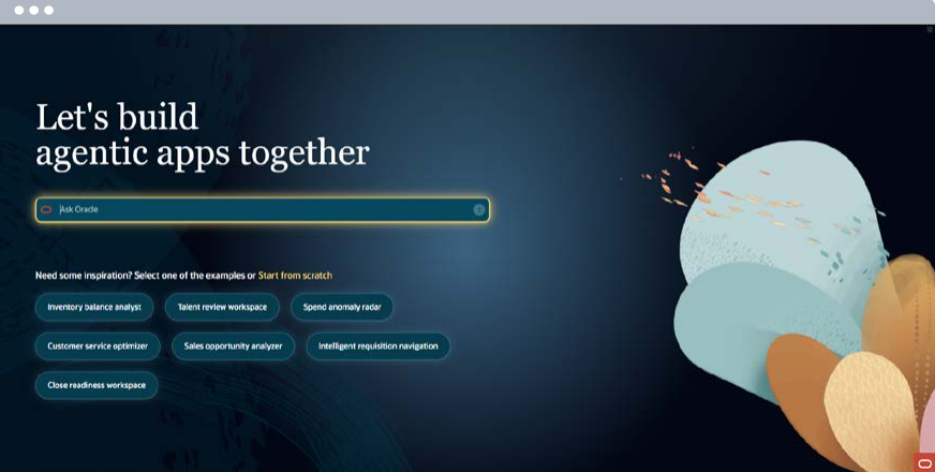
AI Agent Studio provides a framework for defining how agents behave, what data they can access, and how they interact with enterprise workflows. Rather than being limited to out-of-the-box functionality, organizations can tailor agent behavior to align with their specific business processes and requirements.
Using AI Agent Studio, teams can:
- Configure agent-driven workflows across ERP, HCM, and EPM processes
- Define inputs, outputs, and decision logic for agent actions
- Control how agents interact with enterprise data and security models
- Extend delivered capabilities with organization-specific use cases
From a technical perspective, this introduces a governed layer of configurability. Agents are not acting independently. They are operating within defined frameworks that ensure consistency, compliance, and alignment with business rules.
This is a key distinction in fusion agentic applications. The value is not just in having AI embedded in the application, but in having the ability to shape how that AI behaves within real enterprise processes.
As organizations adopt agent-driven workflows, tools like AI Agent Studio enable a more controlled and scalable approach, allowing teams to move from experimentation to repeatable, production-ready use cases.
Impact Across ERP, HCM, and EPM
The introduction of fusion agentic applications changes how work is performed across enterprise functions.
Oracle Fusion Cloud ERP
Agents can assist with:
- Financial close activities
- Reconciliation processes
- Invoice validation and exception handling
These processes shift from manual execution to guided workflows with automated orchestration.
Oracle Fusion Cloud HCM
Within HCM, agents can:
- Respond to employee inquiries using contextual data
- Guide users through HR processes
- Surface relevant policies and actions
This reduces reliance on manual support and improves response times.
Oracle Fusion Cloud EPM
In EPM, agents can:
- Analyze planning data
- Identify risks or anomalies
- Recommend adjustments to forecasts
This enables more dynamic and data-driven planning cycles.
From Workflow Execution to Workflow Orchestration
One of the most important technical shifts introduced by oracle fusion agentic applications is the move from execution to orchestration.
In traditional systems:
- Workflows are static
- Users follow predefined steps
- Exceptions require manual handling
In agent-driven systems:
- Workflows are dynamic
- Agents adapt processes based on context
- Exceptions are identified, analyzed, and resolved with guidance
This orchestration layer allows systems to handle variability more effectively, which is critical in complex enterprise environments.
Governance, Security, and Control
As AI becomes more embedded in enterprise systems, governance remains a critical consideration.
Oracle fusion agentic applications are designed to operate within existing enterprise controls:
- Role-based access determines what actions agents can perform
- Audit trails track agent-driven actions
- Business rules ensure outputs align with organizational policies
From a technical perspective, this ensures that AI does not bypass controls, but instead operates within them.
For organizations in regulated industries, this is essential. The introduction of AI must enhance compliance, not introduce risk.
Coexistence with Traditional Interfaces
Despite the shift toward agent-driven interaction, traditional interfaces are not disappearing.
Forms, dashboards, and reports will continue to exist. However, they will increasingly be complemented by AI-driven interaction layers.
This creates a hybrid model:
- Users can still navigate traditional interfaces when needed
- AI agents provide shortcuts, guidance, and automation
- Over time, reliance on manual navigation decreases
This coexistence allows organizations to adopt fusion agentic applications incrementally rather than through a full system redesign.
A Practical Approach to Adoption
For organizations evaluating oracle fusion agentic applications, the focus should be on targeted use cases rather than broad implementation.
Key starting points include:
- High-volume, repetitive processes
- Areas with frequent exceptions
- Workflows that require cross-functional coordination
By introducing agent capabilities in these areas, organizations can demonstrate value quickly while building internal familiarity with the technology.
What’s Next
Oracle Fusion agentic applications represent a shift in how users interact with enterprise systems, moving from navigation and task execution to more intelligent, outcome-driven experiences. As these capabilities continue to evolve, organizations have an opportunity to rethink how work gets done across ERP, HCM, and EPM.
If you’re exploring how these capabilities fit into your Oracle environment, the next step is identifying where agent-driven automation and AI can deliver the most value within your existing processes. The Elire team works with organizations to evaluate, implement, and optimize Oracle Cloud solutions, helping align new capabilities with real business needs.
To learn more, explore our Oracle Fusion Cloud Services page to see how we support Oracle Cloud and AI-driven initiatives. You can also watch our AI agent demos on YouTube to see how these capabilities work in real scenarios. To stay up to date on Oracle innovations and best practices, sign up for our Cloud newsletter and follow Elire on LinkedIn.

.png)

.png)