

.png)
Organizations often rely on Oracle Cloud Enterprise Performance Management (EPM) to support complex business processes that involve multiple integrations, business rules, metadata updates, data loads, and platform tasks. Coordinating these activities manually or through separate jobs can increase administrative overhead and make troubleshooting more difficult.
In Oracle Cloud EPM, the Pipeline feature is an advanced Data Integration capability introduced by 23.06 version that allows users to orchestrate multiple independent jobs (e.g., data load rules, business rules, cube refreshes, and file operations) into a single, automated, sequential, or parallel process.
The Pipeline feature results in enhanced control, scheduling, and visibility over extended data integration and preprocessing workflows.
What are the Core Capabilities of EPM Pipelines?
The Oracle EPM Pipeline feature provides several capabilities that extend traditional Data Management batch processing and support more sophisticated integration architectures.
End-to-End Orchestration
EPM Pipelines replace traditional Data Management batch functionality by grouping jobs into logical stages. This allows organizations to orchestrate preprocessing activities, data loads, business processes, and post-processing tasks within a single workflow, ensuring each step executes in the proper sequence.
Diverse Job Types
EPM Pipelines support a wide range of job types, including integrations, business rules, substitution variables, and EPM platform tasks. They also support file management activities, such as unzipping and copying files across object storage and remote SFTP servers, enabling more comprehensive workflow automation.
Cross-Pod Operations
Organizations can manage and trigger jobs across multiple Oracle EPM environment instances from a single centralized Pipeline. This capability simplifies administration and helps coordinate activities that span multiple applications or environments.
Conditional Branching
Pipelines can be configured to execute different actions based on the success or failure of previous jobs. For example, a Pipeline can stop execution when an error occurs, trigger notification emails, or route processing to alternative steps, providing greater control over workflow execution and exception handling.
What do EPM Pipelines Deliver? Better Automation & Data Management
In addition to workflow orchestration, Pipelines can be integrated into broader enterprise automation frameworks. Administrators can build and view Pipelines in the Data Integration section under Data Exchange. Users can easily automate Pipeline execution using:
- EPM Automate: Use the runPipeline command to launch your definitions via scripts
- REST APIs: Trigger pipeline jobs directly using standard REST operations
- Task Manager / Groovy: Embed Pipeline runs directly in Task Manager schedules or Groovy business rules
For a deep dive into configuration, supported job types, and best practices, check out "Using the Pipeline" in Oracle's Help Center.
Oracle EPM Pipelines Use Cases
While the Pipeline feature offers significant technical flexibility, its value becomes most apparent when applied to real-world business requirements. The following implementation examples demonstrate how organizations have leveraged Pipeline architecture to solve complex integration challenges.
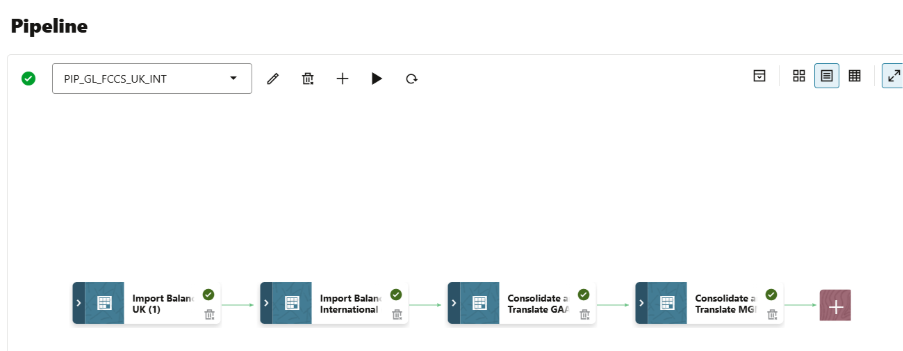
Scenario A: Business Specs Workflow: EPM FCC End to End Close
- Importing ERP Balances for regional ledger from ERP Fusion cloud
- Importing ERP Balances from International ledgers COA’s
- Consolidating & Translating GAAP Hierarchy
- Consolidating & Translating Management Hierarchy
Proposed Solution:
We created Pipeline to construct based on above specs that had 4 different stages depicted below:
- Each stage was sequentially constructed from the individual component data exchange jobs factoring the dependencies.
Scenario B: Business Specs Workflow: Metadata Integration
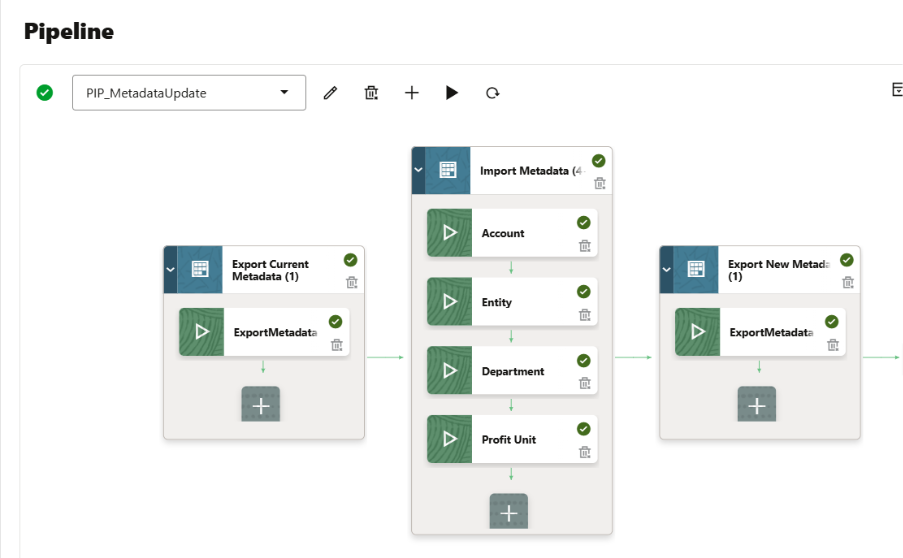
- There was a request to integrate Oracle EDMCS with Oracle EPM application cohesively
- Export of the existing metadata hierarchies of the dimensions from EPM FCC application
- Import of the updated metadata hierarchies for key dimensions specifically Account, Entity, Department & Profit Centre in the target EPM FCC application
- Export latest metadata reflected in the EPM FCC application for validation and checks
Solution:
Implemented pipeline to factor the above stages in the design illustrated as under:
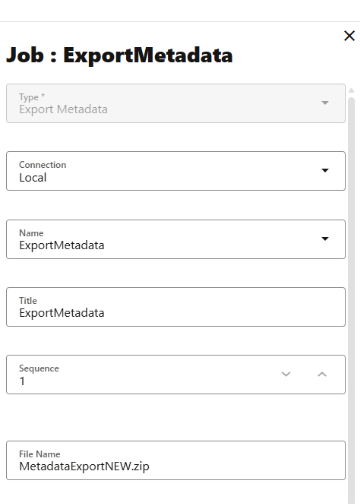
This leveraged individual jobs like below for import of COA and export of the metadata:

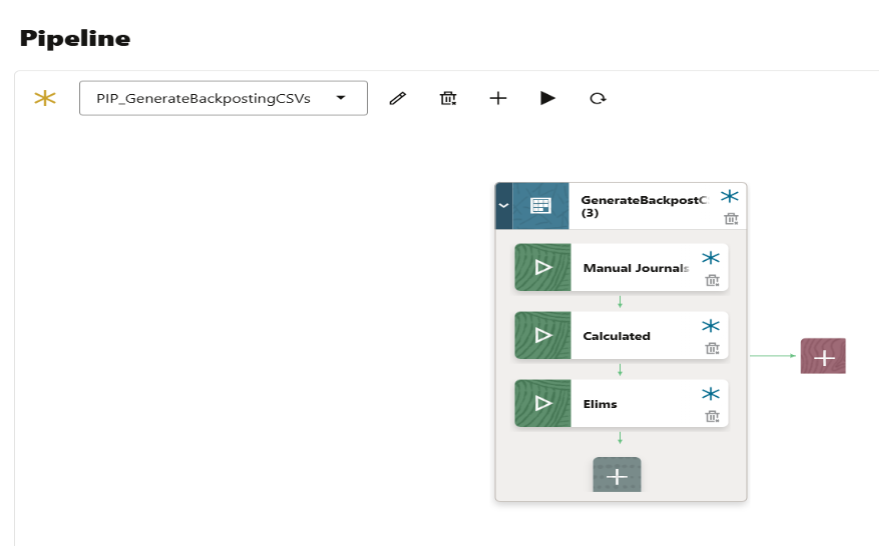
Scenario C: Generating consolidated and elimination data from EPM FCC for back posting to source ERP
Solution:
Designed the pipeline to selectively extract different data sets as per business specs as evident in below snippet of the pipeline
What's Next?
Oracle EPM Pipelines provide organizations with a powerful framework for orchestrating complex integrations, automating business processes, and improving visibility across the Oracle EPM ecosystem. Whether you're supporting financial close activities, metadata management, ERP integrations, or enterprise-wide automation initiatives, a well-designed Pipeline strategy can help reduce manual effort, improve reliability, and create a more scalable operating model.
As organizations continue to expand their use of Oracle EPM, the ability to connect and automate processes across applications will become increasingly important. By leveraging the full capabilities of Pipelines, organizations can streamline operations, strengthen governance, and maximize the value of their Oracle investment.
If you're evaluating Oracle EPM Pipelines or developing your broader EPM integration strategy, Elire's experts are here to help. Explore our Oracle EPM Services to learn how we support organizations throughout their Oracle Cloud journey, or contact us to discuss your specific business and technical requirements in greater detail.
For more Oracle Cloud insights, product updates, implementation guidance, and expert perspectives, subscribe to our monthly Cloud Newsletter and follow Elire on YouTube and LinkedIn for the latest content from our Oracle specialists.




.png)
.png)
